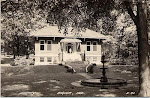
Among the men who took an active and prominent part in the early history of Steuben County, few are more worthy of mention than Dr. James McConnell. He was born in Morefield, VA., September 17, 1810, and was the second in the family of James and Elizabeth McConnell. He received his education at Lovingston, New Glasgow and New London, VA., under his father's watchful care, and soon after, entered the office of Dr. Lamb, of Brownsville, Fayette Co., Penn, completing his medical studies with Dr. Porter, formerly Professor of Anatomy in Jefferson Medical College, Philadelphia.He began practice at Brownsville, Penn, and about 1833, moved to McConnellsville, Ohio and in May, 1835 came to Lima, La Grange County Ind. The territory of which Steuben County, Ind., now consists, was then a part of La Grange County, and it will thus be seen that he was identified with Steuben County from the very commencement of his career in Indiana. He remained at Lima until November 1, 1836, when he moved to the "Vermont settlement," now Orland, where he continued the extensive practice he had enjoyed in Lima. He was the first physician of Steuben County, and a man of fine education and undoubted ability. In April, 1837, he was elected Clerk and Recorder of Steuben County for the term of seven years, and located his office int he log cabin of Jacob Stayner, on Jackson Prairie, removing to Angola in the fall of 1837, where the county seat had been located and a frame office erected for his occupancy.
He was married in Angola, in January, 1841, to Mrs Julia Whitaker, sister of Judge Thomas Gale, one of the pioneers of Angola.
In 1843, Dr McConnell resigned his office and began practice as an attorney, but death cut short his labors, he dying October 9, 1844. Most of the old settlers remember him as a man of integrity and true worth; energetic, obliging and capable; possessed of the finer attributes of manhood and endowed with a strong, logical brain. Although first settling in Lima, he was from the beginning, intimately associated with the early, sturdy pioneers of "Old Steuben," of whom their descendants may well feel proud. De James McConnell, though dead nearly forty years, is still spoken of in words of kindness and honor.
Atlas of Steuben County 1880
Friday, August 3, 2012
Monday, July 2, 2012
JOLLY BROTHER'S FISHING CLUB
The first excursion of the "Jolly Brothers Fishing Club" of this place consisted of a trip last Thursday, to the beautiful body of water eight miles northeast of Angola, known as Lake Gage. By a singular, and we must say rather sel-fish arrangement, none but the officers were allowed to participate in the inaugural fishing party of the club. Every one of the grand Moguls, however, took particular pains to be present at the inaugural ceremonies on the south bank of the lake, as the following list of attendants, which we glean from the secretary's book, show: T. B. Williams, president; O. Carver, vice-president; J. Tooley, 2nd vice-president; J. Gale, treasurer; M. Stiefel, secretary; L. M. Sowle, night-watch. Leaving business cares behind, the party started at one o'clock P.M., and, after a pleasant ride through a fine country, at 3:30 the boys neared the lake. With hearts light and pockets filled with straggling poles, and with long worms on their shoulders, the "Jolly Brother's Fishing Club" hopped out of the three-seated carriage, to the great relief of its springs, and to the complete joy of about a million hungry mosquitoes. After the battle with the insects had opened, and while busy rigging up the boats, Mr. O Leas put in an appearance with commissary stores which consisted of eatables, ___ables, tenting, etc. After partaking of a hearty supper and indulging in a fine smoke, the next thing in order was a row on the lake, ending up with a healthy bathe. Before retiring, a social game of pedre was engaged in by all except Moses, who laid his weary bones away in his hammock for the purpose of courting "tired nature's sweet restorer - balmy sleep" On being called at regular intervals of fifteen minutes, he gave up in despair and joined in shuffling the pictures. Just here the party received a pleasant visit from Joseph Butler and his friend, Mr. Gilliad. The club dished up the best in the shop and in return were tendered the hospitality of his house. At midnight all retired except, of course, the night watch, Sowle. The boys slept probably fifteen minutes, when they were awakened by a slight noise right over them, about as loud as could possibly come from a heavily loaded shot gun. The gun was expressly fired, as Lee afterward stated,while President rubbed down his shoulder with arnica, for the purpose of keeping away the howling beasts, but the old thing suddenly rewarded him for his pains by kicking him down the bank into the lake to bathe.
All sleep soundly, even to the night watch until three o'clock, when the fishermen were awakened by the patter of rain upon the tent. Shortly after, "Mose" astonished the club by paddling out to the President's floating bladder and hauling in an immense "pickeral." The Club, however, afterward, with only one dissenting voice, (that of Moses) decided to call the curious specimen of the finny tribe a regular dog fish. The worthy secretary of the club was sorely disappointed that morning in not having pickerel for breakfast. The boys, however, took in some fine fish that Friday and after exhausting their eatables and particularly their ____ables, the party returned home, we learn, for the express purpose of getting ready for another trip.
Steuben Republican July 21,1875
All sleep soundly, even to the night watch until three o'clock, when the fishermen were awakened by the patter of rain upon the tent. Shortly after, "Mose" astonished the club by paddling out to the President's floating bladder and hauling in an immense "pickeral." The Club, however, afterward, with only one dissenting voice, (that of Moses) decided to call the curious specimen of the finny tribe a regular dog fish. The worthy secretary of the club was sorely disappointed that morning in not having pickerel for breakfast. The boys, however, took in some fine fish that Friday and after exhausting their eatables and particularly their ____ables, the party returned home, we learn, for the express purpose of getting ready for another trip.
Steuben Republican July 21,1875
Wednesday, June 6, 2012
The Indians and Steuben County
By Hon. Stephen A. Powers
I quote from a letter written by my uncle, Stephen Powers, to his mother, July 12, 1837:
"On May 23rd, Winn and Calvin and I with our families started from Ontario county N.Y., with our ox teams. Winn and I arrived in the state if Indiana July 3rd, and we reached brother Clark's place July 8, 1837. Clark had a double shanty nearly done and we all moved in with him. We were seven weeks lacking two days on the way and Calvin has not arrived yet.
In my uncle's family at that time was his little daughter, Dolly Jane, who is now Jane Stayner, and is the only survivor of the Powers family that settled in York Township over 75 years ago.
My Uncle Steve soon moved two miles west, on the Maumee road (US 20), where he located in a log cabin. Just south of them was an Indian village of which my cousin Jane has told me some incidents.
Here lived forty Indians presided over by a chief. In the thick of the woods they had a large low log wigwam, built up on three sides of logs, chinked with moss and covered in bark. The east side was open except as they hung up blankets and hides as curtains. In winter they cooked inside this wig-wam and in summer outside. They piled up leaves and covered them with bear and wolf skins for beds. When the weather was unfit to live outside, all of these Indians lived in this big wig-wam.
There were friendly to the whites.
The old chief had a little papoose of which all were proud. He would bring it to my uncle's house to the delight of the whole family. It was not strong: was taken sick and died. Then these Indians exhibited their grief by physical demonstrations and loud lamentations. My uncle's folks went over to assist them in the time of their bereavement, which they seemed to appreciate. After a day of mourning and moaning, they wrapped the papoose in a cloth and then placed it in it's mother's arms. With the chief at the head and the mother following with the little papoose, in a single file, all went down the trail through the great forest to the southwest and came back the way they went, without the little baby, and they never told where they buried the child, but it was supposed they laid it to rest in a mound just north of Pleasant Lake.
They always wanted to swap, pailful for pailful. One day they came to Aunt Mary Ann's to swap a pail of strained honey for a pail of ears of corn, which for some reason Aunt would not do. This angered the squaws, so they hunted up Uncle Steve; cut some big whips and gave them to him with which to whip his squaw. The next day they came and pointed fingers at my aunt and laughed like fiends, and said: "Smokeman whip squaw." After this they were friendly. Then the old chief came over and wanted three bullets and three charges of powder, which aunt gave him, and in an hour he brought her a big wild turkey, and to still show his desire to make up for the disrespect of the squaws, he came again and called for three charges of powder and three bullets, which she gave him. He soon brought her the hind quarters of a deer, and said: "Take hide Fort Wayne--bring papoose beads" and this he did.
In 1840 the government officers and soldiers rounded up 500 Indians in a bunch near Powers settlement in York Township. They came along their familiar trails, from their wig-wams, from their native they came, leaving the graves of their forefather's unmarked; their history unrecorded and their eloquence unsung. The squaw's came out of the deep woods to the meeting place, carrying the burdens. Their papooses, strapped to sheets of basswood bark, were fastened upon their backs. They would stand these precious loads against the great forest trees while they patiently waited the final order which was to part them from their familiar haunts and hunting grounds, forever.
Samuel Brooks says it was a sad scene. The braves came with many ponies, which attracted the boyhood curiosity of young Brooks and impressed the event upon his memory.
It was the old story; they were steadily driven away from their ancient homes, until now we can find only a sorry remnant of a once mighty people.
Steuben Republican - January 15, 1913
Thursday, May 17, 2012
HIRAM TOWNSEND - CIVIL WAR SOLDIER
Hiram L. Townsend
Post. No. 405., G.A.R.
Located at Metz, Indiana
At the formation of a G.A.R. post at Metz, in the selection of a representative name from deceased comrades, among others the name of Hiram L Townsend was proposed. Capt W. H. Cole being present gave a historic and fitting tribute of the soldier life and soldier qualities of comrade Townsend. The result was a post being chartered Aug. 8, 1885 with 16 charter members, known as the Hiram L. Townsend Post G.A.R. No 405.
Taken from :
War For The Union 1861-1865, A Record of its Defenders Living and Dead From Steuben County, Indiana and History of Veteran Organizations and Kindred Associations
by Jesse Carpenter 1888
Labels:
Townsend Hiram L.
Saturday, April 21, 2012
BOOZE RUNNERS IN GUN FIGHT
Gritty Sheriff of Steuben County
____________
Males Capture After Score of Shots Are Fired - Second Capture of the Week
________
After a running gun battle extended over ten miles, and a knock-down fight, Sheriff Zimmerman Monday afternoon captured James Henderson and Ernest Chalmers, giving their address as Indianapolis, driving a REO Speed Wagon loaded with sixty cases of beer. The men were lodged in the Steuben county jail and the load was confiscated. Zimmerman with Robert Denman, were in the Rickenbacker roadster taken from bootleggers the day previous, riding on the Fox Lake road near the railroad crossing a mile from Angola when they approached the truck driver from the rear, and were startled by a rifle shot from the truck and the whiz of a bullet past them. They immediately took after t he truck, Denman driving the card, while the sheriff stood on the running board and opened fire with his revolver. Probably thirty shots were exchanged in the battle which continued over the hilly and winding road for five miles and then onto the gravel road that runs down past the Ed Smith farm and onto the Ashley road, shooting through the dust and across the fields as they turned corners. The sheriff ran out of ammunition and stopped at a farm house and secured a rifle and continued the pursuit. At Ashley the truck men gave up the race, and after a fistic encounter submitted to arrest. Their weapon was a Winchester rifle. Bullet holes in the back curtain of the truck and broken bottles showed where the sheriff's shots had taken effect, but no shot of the booze runners registered on the sheriff's car.
The booze runners claimed they recognized the roadster in which the sheriff was riding as an automobile belonging to some Indianapolis hijackers, and that they had decided to save their load and one of the men had gotten back into the body of the truck to shoot at the approaching driver. The roadster in which the sheriff was riding was one he had captured Sunday forenoon about six miles north of Angola, after a chase from Lake George, where Sheriff Zimmerman's attention was attracted to the car by the fact that it sat so low on it's springs. The roadster, which was a new one, the speedometer registering only 3400 miles, was camouflaged with a camping outfit, even to a pair of ladies shoes being exposed. Zimmerman was riding with Robert Denman in his car, and they started in pursuit and the men ahead increased their speed to a high rate. When the first car reached the curve on the Sellers farm five miles north of Angola, it was turned back north of the old road, and there it was overtaken by the sheriff, and the occupants were placed under arrest. They gave their names as Charles Geseking and William Mock, of Indianapolis. The load consisted of wight cases of beer and two cases of whiskey. The men claimed that they did not know they were being pursued but that they had turned into the byroad to change license plates. The car had Michigan plates on it, and a pair of Indiana plates in the car. The car and contents were confiscated and the men placed in the county jail. They claimed the was was mortgaged and could only be confiscated subject to mortgage claims.
Geseking and Mock, the bootleggers captured Sunday, appeared before Mayor Stevens Tuesday afternoon and pleaded guilty to transporting liquor and were fines $ each and sentenced to days in the penal farm and the card was ordered sold. The other men asked for a continuance until their attorney could come from Indianapolis. An Indianapolis city directory does not contain any of these names.
Steuben Republican July 21, 1926
Geseking and Mock, the bootleggers captured Sunday, appeared before Mayor Stevens Tuesday afternoon and pleaded guilty to transporting liquor and were fines $ each and sentenced to days in the penal farm and the card was ordered sold. The other men asked for a continuance until their attorney could come from Indianapolis. An Indianapolis city directory does not contain any of these names.
Steuben Republican July 21, 1926
Friday, April 13, 2012
GRAVE ROBBERY
The Body Snatchers At Work in the Vicinity
-----------------------------------------
The Grave of David Tugwell Robbed of its Inmate
About the time we went to press last Wednesday morning, the news came to town that the grave of Mr David Tugwell, who died at his residence two miles north of this village and was buried in what is known as the Sowles' settlement burying ground, has been robbed of the body. Mr William Anderson brought the news to town, with a piece of the coffin which had been found by those examining the grave.
It seems that, some days previously, it had been noticed that the grave showed that it had been tampered with, but nothing was done toward investigating the matter until last Wednesday, when, after a consultation by several of the citizens of that neighborhood, it was determined to examine the grave and ascertain the facts, whereupon Mr Anderson and others proceeded to open the grave and found the coffin empty - containing only the grave clothes.
It seems horrible to think of the fact that the ruthless, inhuman body snatcher has come to our vicinity and plied his nefarious work at the graves of our own well-known and respected friends, friends dear to heart recently rent by sudden bereavement. Mr Tugwell was one of our most respected old citizens, one who had worked hard, finished his labors and lain down to rest in the embrace of mother earth, and there his body ought to have been left in peace.
Herald Republican Wednesday December 19, 1877
72 Years In Angola
Frank Cary Reached That Distinction Yesterday
Has Seen A Great Many Changes - Made Three trips To California Since That Time
Frank Cary, then being a well developed youth, still retains vivid impressions of early scenes about this locality. The public square, instead of being paved and ornamented with lights, a lawn and a monument, contained two pond holes, a stump, and a clump of hazel brushes. The old court house stood at the southeast corner of the square. Jesse Mugg was a tavern keeper and Elisha Sears kept a store where Williamson's hardware store is now located. This building was built with hewn timbers, even the studding, and the upper part was used for a hall and lodge room and was home in time of both the Odd Fellow and Masonic lodges. Mr Cary was one of the charter members of the Masonic lodge and kept his membership unbroken to this day, and his son and grandson are both members of the same body. Mr Cary has been zealous in his attendance on the order, and his work in the ceremonies has made a decided hit with all the later members.
Mr Cary has visited California three times since living here, the first time in 1862, by wagon train, when he was in charge of 12 horses, and was five months on journey. He returned by water, crossing the Isthmus of Panama and resuming his journey to New York. A brother accompanied him, returned by way of the horn. He also went once by water, starting from New York.
Mr Cary remembers well the men of the early days, including Judge Gale, Cornelius Gilmore, A. W. Hendry and others who had much to do with shaping Angola's early history. He recalls with ease the time when this vicinity was an ideal hunting place, abounding in squirrel, wild turkeys, duck, and other small game and has seen the erection of nearly all the homes, the city now being more than 10 times as large as when he came here.
Herald Republican July 4, 1917
Labels:
Angola,
Cary Abel,
Cary Frank,
Cary John,
Cary William
Subscribe to:
Posts (Atom)