Local History and Genealogy

Wednesday, June 23, 2010

Concert Hall Block Retains Its Ornate Architectural Design Over 80 Years

Another picture of the Central Block which was erected on the public square in 1873-74 has come to light in a collection owned by Senator Willis K. Batchelet, and shows that the building was quite pretentious for its period.  Occupying two lots it surpassed its neighbor, the Patterson block also a three-story building across the street but which was constructed only on a single lot.  At the left was flanked by the Union Bank constructed near the same time.  At the far left may be seen a portion of a frame building which was the old Orton Eagle House, the present location of the Odd Fellows block, the home of J.C. Penny store.  The Pow bank occupied the corner room in the block while Sowle& Bodley store bordered on both sides with two entrances.  The I.M. Sowle and Co. merchant tailors were on the second floor facing the public square and further to the rear was the Domestic Sewing Machine Rooms.  The Milo Dawson grocery store occupied the small frame building back in the corner of the square.  Concert Hall occupied the entire third floor of the double block. this room still being intact today.

Steuben Republican March 13, 1957

Tuesday, June 15, 2010

4th of July buried on Angola square more than a century ago

     More than a century ago, the city of Angola celebrated the 4th of July in a most unique and bizarre fashion.
     Mrs. Jesse Greenamyer of Angola found a clipping noting the "festivities" and submitted it.
     A Fourth of July celebration had been advertised for Angola.  Bills had been freely circulated and masks
procured for a fantastic parade which promised to be immense.  Before the day arrived for the jubilee, however, an attempt was made to collect money from the business men of the town to pay the expenses, but
they refused to put up the necessary funds.  When this fact was learned, those who had the matter in hand declared the celebration off and then resolved to publicly bury it.
     On the morning of July 4, 1859, the people of the town, who were not let into the secret, were surprised to find a grave twelve feet long and three feet deep, at the northeast corner of the public square, and curiosity was at a high pitch.  In the meantime about fifty men had assembled at Nichols and Miller's wagon shop south of the public square and organized a fantastic parade, and before the people of the town had an inkling of what was being done, the procession had started, and a weird, grotesque and solemn scene it presented.
Every man wore a false face, so that his nearest friend could not recognize him more than if he had been a native from the wilds of Africa.  At the head of the parade rode the captain, W. C. Weicht, on a jackass.
His face was covered with as horrid a looking mask as one could imagine; in his right hand he carried a sword, his feet were encased in two paint kegs for stirrups and with mammoth spurs he goarded the jack.
Next came the musicians, Chris Stealy playing the fife, Henry Nichols the snare drum, and Thomas R.
Moffett the bass.  Following them were the pall bearers carrying the coffin the which had been placed a dummy with a mask for a face.  The casket was covered with a thick, black pall.  Following this, with slow,
measured tread, came the balance of the company.
     After parading on several of the principal streets where they were seen by scores of wondering people,
they surrounded the grave where the pall was removed and the coffin gently lowered amidst the groans of the mourners.  Asa M. Tinker then delivered a solemn oration over the remains.  Just before the close of the
exercises, while Mr. Tinker was in the midst of the most impressive part of his address, a man drove by with a horse, and jack struck up its doleful tune.  At this juncture the captain gave it a jerk to make it hush, when they both fell into the grave, to the great consternation of the chief mourners.  After quite a struggle, the animal, with the captain still on its back, got out on good footing.  The grave was then filled, with the coffin left at the bottom, and thus it remains to the present day.
Steuben Republican, June 26, 1974.

Friday, June 4, 2010

Silas Doty

Silas Doty, Noted Character of the 40's, Tried for Murder Here

Nearly 100 years ago there roamed over the hills of northeastern Indiana a notorious character bearing the name Silas Doty.  He was born in St. Albans , Vermont, May 30, 1800.  His parents were Christian people.  But in spite of their teaching he grew up an incorrigible boy.  The exploits of his early life began in the state of New York and extending into Ohio, Indiana and Michigan, embraced burglary and every kind of larceny and the making and disposing of counterfeit money.  IN 1825 while living in Franklin County, New York he married Miss Sophia Adams, a girl of good family, and for a time refrained from his evil ways. Later, falling in with some old companions he drifted again into his old ways.  He was at different times arrested but manage to escape conviction by means of false testimony given by confederates.  In 1834 he removed his family to Lenawee county, Michigan.  Here he resided for five years, during which time he became allied with the Black Legs who operated in southeast Michigan,  northeast Indiana and western Ohio.  He and a companion named Wickes stole a number of valuable horses and other property.  While living here he managed to escape arrest.

In April 1839, he and his family moved to Steuben county, Indiana not far from the little village of Jamestown.  Here he bought a piece of land and set about making it his home,  That summer a young man named Lorenzo Noyes came along looking for work.  Mr Doty employed him for the season.  He was a good ox teamster and gave good satisfaction as a laborer.  He was a young man, probably little more than 20 years of age and had no relatives in this part of the country.  He was one of that type not easily influenced and as he got next to Doty's way of doing things they failed to agree and frequently quarreled.  One day Doty threatened to whip him.  He received a cordial invitation to pitch it.  But mauling men was a different proposition from stealing and Doty who was of a rather light build, did not make any move to carry out his threat.  Some time after this they had another quarrel and Noyes called Doty an old thief and threatened to expose him.  Finally he said he would leave and gathering up his clothes he started west.  Doty who did not like to see him leave in such an angry mood followed him and tried to conciliate but the more he talked the more angry Noyes became and finally turned around and began to call Doty hard names and said he would tell all he knew about him.  Doty, who was greatly excited, struck him over the head with a heavy cane.  Noyes fell to the ground, quivered a few minutes and then laid perfectly still.  Doty worked several hours to bring him to but in vain.  The man was dead.  With the taking of this man's life, a terrible feeling of remorse took possession of Doty.  He was at a great stand as to what disposal to make of the body.

About 40 rods north of where the killing took place was a tamarack swamp.  Doty managed by carrying and part of the way dragging to get the body there.  Finding a soft mirey place he forced the body down into it, out of site.  He then covered the place with brush and other rubbish.  He then returned home where he washed the blood stains from from his clothes and went about his business as usual.

When asked by the neighbors concerning Noyes, he replied that he got mad and left.  It was not until 1842 that Noyes body was found.  On the 12th of May that year parties hunting for cattle found the remains.  The coroner of Steuben county was notified and held an inquest at that time.  It was found that the deceased came to his death by violence, namely a fractured skull, and that it was believed that the body was that of  Lorenzo Noyes.  Dr D. B. Griffith, who was present at the inquest, took charge of the body and  it is said preserved the skull for many years.  Suspicion at once rested  heavily on Silas Doty.  In the meantime that character was in trouble again, having stolen a horse on the edge of Michigan.  For this crime he was arrested and sentenced to prison for two years.  Late in 1842 the grand jury returned an indictment for murder against Doty.  The prosecuting attorney of Steuben county was at this time Robert Douglas.  As Doty's sentence did not expire until April 9, 1844, the matter rested for a time.  Doty however, managed to secure able defense council for his defense, John B. Howe of Lagrange county and David H. Colerick of Fort Wayne.  This, the first murder trial in Steuben county, began April 7, 1844, and continued several days.  The counsel for the defense put forth great effort and the result was that the jury failed to agree, eleven of the jurors being for acquittal. It is said that the crowd was so great that it swayed the court house to the east several inches.  On the prayer of Mr. Doty his case was taken on change of venue to Allen county.  He remained in jail at Angola until fall when his trial was held at Fort Wayne.  This trial was full of interest as the former one, many witnesses from Steuben county being present and even the skull of the murdered man was brought in as evidence.  The result of this trial was that Doty was found guilty of murder in the second degree, and was given a life sentence.  He was taken to Jeffersonville where he remained a year or more at hard labor.  His attorneys, after some delay, got the case before the Supreme Court, where the decision was reversed.  Doty was granted a new trial and returned to jail in Angola.  As Mr. Colerick and Mr. Howe did not want to risk another trial in Steuben county, they got a special act of the legislature for a trial in LaGrange county.
About this time Doty broke out of jail by sawing a hole through the floor.   He was soon captured  and brought back.  With a view of making escape impossible, a pair of fetters connected by  12 inches of chain weighting 19 1/2 pounds were riveted on his ankles, Doty had secreted two steel case knives under his clothes, and with these which he fashioned into saws, he sawed the iron bars of his prison window loose and again made his escape.  Going to the prosecuting attorney's barn he took his horse, which was an unusually good one, and rode to his home, riding sideways on account of his fetters.  Here, with a cold chisel he soon removed his shackles,  Bidding his family adieu, held the country.  At this time the Mexican War was raging and Doty did not stop until the borders of that country were reached.  He joined General Taylor's army and served till the close of the war.  He then drifted back to Michigan where his family was living near Hilldsale.  Here he seems to have got in bad again as he was soon arrested, probably for stealing.  His trial was held at Hillsdale and the judge, knowing something of his past activities gave him a 17 year sentence.  By good behavior he was released after 15 years.  Strange to say, after his release he soon got into trouble again and served two other terms, one of two  and one of four years.  He was now in the late autumn of life with it's sear and yellow leaf and winter's frosts were settling on his withered brow.  A third of his life had been spent in prison.  After he finished his last prison term in went to the home of his son in Reading.  Here he died March 13, 1876.  In his last days he confessed to much of his ill doing and came to a full realization that his life emphasized the truthful saying, "The way of the transgressor is hard."

Silas Doty was a man, in many respects, of more than ordinary ability and might have made a record in a legitimate line of business that would have been a source of pride to his relatives and friends.  His children seem to have inherited their mother's traits of character rather than his and were all highly respected citizens.

Written by Homer H. Brown
Steuben Republican January 5, 1938


Old Sile Doty

Old Sile Doty is dead.  He died at the residence of his son, William Doty, in Reading, Michigan last Sunday evening, the 12th aged 77 years.
Who does not remember Old Sile Doty?  The widely known, inveterate and persistent old thief that ever infested this part of the world, so peculiarly constituted that he would steal for the fun of it, steal from wealthy or well-to-do and give generously to his poor or destitute neighbor - for he was kind and generous.
Old Sile Doty has been for the last thirty-five years, in his line, the most notable character we have ever had in our midst.  His career in this county and in the counties of Hillsdale and Branch has been so well known that the announcement that it has now come to an end will revive in memory the old time of his many peccadillos.  More than half his life has been spent within the walls of prison, but he hardly took his incarcerations as punishments.  He regarded the penitentiary as his home and was ill at east outside it's walls.  But his body has now reached its last great earthly prison, and will not be released until the lapse of time shall usher the resurrection day and the last sentence pronounced to a court far above that of human wisdom or mercy.

Steuben Republican March 15, 1876

Saturday, May 29, 2010

Memorial Day 1954

Colorful Ceremony on Memorial Day Marked By Band and Parade

Calling for a renewal of the patriotic fervor of earlier days, in a spirited address here last Sunday, Judge Lowell Pefley of the Whitley county circuit court deplored the disinterest in public affairs on the part of the citizenry which fails often to avail itself of even the right to vote.

Judge Pefley spoke at the annual Memorial Day service in Monument Place in Angola Sunday noon. The service was attended by the usual large crowd of interested patriotic citizens.  Preceding the program a parade was  formed several blocks west of the public square and marched to the mound surrounding the imposing Steuben county memorial to the veterans of the war of 1861 to 1865. 
Maurice Whitlock was the parade marshal.  Merritt D Boyer, past commander of Angola Post 31 American Legion served as general chairman, aided by members of the post headed by George C. Myers as commander. The parade including three bands from the Angola schools, patriotic organizations, Angola school children, Boy Scouts, American Legion members, and members of the Veterans of Foreign Wars.  Traffic on the two U.S. highways was detoured through Angola during the Memorial observance.

So far as can be ascertained, the custom of decorating symbolic graves on the mound began shortly after the organization for the Grand Army of the Republic Post in Angola, mustered March 29, 1883, and named for Lt, Col Baldwin H Crosswaite of the 44th Indiana Volunteers, who was killed Feb. 18, 1862, at the age of 40.

At first, wooden markers resembling shingles were placed about the mound for Memorial Day observances, these being kept for many years in the GAR headquarters on the public square overlooking the mound.  Following World War I, the American Legion replaced these crude markers with the present day white crosses which are placed in the four segments of the mound early each Memorial Day.  More than 1,200 volunteers went from Steuben county to serve in the Civil War, out of a total population of 10,000, and Steuben county's patriotic record has been sustained throughout the years since Dan Wisel, Steuben county's last surviving Civil War veteran, died at his home in Salem Township Jan 3. 1940 at the age of 102.

Citing the four freedoms of which all should be conscious, Judge Pelfrey said, "And I would, add a fifth freedom, which we also tend to forget and that is the freedom we have as citizens to help our neighbors in time of need, our freedom, as we wish, to help and old lady to cross the street, to help the orphans in Korea, and to help the hungry and the needy wherever we wish, a freedom denied those living under the shadow of Communism, and behind the Iron Curtain, where a man is forced to forget unselfishness and where the atmosphere denies him the right to be generous and to help his neighbors.

Following the posting of the colors, in which units form the Angola American Legion Post participated, the invocation was given by the Rev. Kenneth Hornbuckle, pastor of the Congregational Church.    Following music by the Angola High School Band, directed by Elwood Nichols, flowers were placed about the white crosses by the school children of Angola, Judge Pefley was introduced by Glen S, Beatty, Mayor of Angola, and following hi address a benediction was given by the Rev, Norman Kistler, pastor of the Fairview Missionary Church and the firing squad of the American Legion gave salute to the dead with "Taps" by Roy C, Bodie Jr.


Steuben Republican  June 2, 1954
Pictures property of Carnegie Public Library of Steuben County

Friday, May 28, 2010

Decoration Day 1901

Following is the list of soldiers and members of the W.R.C. (Women's Relief Corps) whose graves were remembered with the dear old flag and beautiful flowers, in the old (Old Angola)  and Circle Hill Cemeteries: 
Circle Hill
Capt. W. H. Cole, Co. A. 129th Ind.
J. H. Chapple, Co. A, 44th Ind.
Wm H. Merritt, Co. K. 111th Mich.
Wm. Hanselman, Co. A, 129th Ind.
John B. Moore, Co. F, 27th Iowa
Austin Pross, Co. E, 13th Mich
Henry Delaney, Co. F, 48th Ohio
Dr. Geo.W.McConnell, Q.M., 44th Ind
Andrew Jackson, Co. H. 74th Ind.
Samuel Clark, Co. H, 5th Mich
Wm. Shore, Co. E, 32nd Ohio
Henry Morrow, Co. D, 142nd Ind
Nathan D. Robinson, Co. K, 104th Ohio
Flem W. Bodley, Co. B, 88th Ohio
Capt. Alex W. Button, Co. H, 112th N.Y.
Andrew Restler, Co. D, 142nd Ohio
Capt. Sidney Lawrence, Co. A. 96th Ill.
Christopher Hart, Co. B, 78th Ohio
James Boline, Co. A, 180th Ohio
Lewis Jennings, Co.E, 151st Ohio
Augustus L. Hubbard, Co. A, 15th U.S. Reg.
Julius VanAuken, Co.A, 129th Ind
Capt. Chas F. Kinney, Co. A, 44th Ind
Samuel Truesdale, Co. E, 74th Ind
Germ Brown, Q. M. 100th Ind
Henry Twitchell, Co. A, 44th Ind
John H. Trainer, Co. H, 75th Ind
John S Tarr, Co.F, 21st Ohio
John C. Stealy, Co. A, 129th Ind


Veterans of 1812
Williard DeWitt
John L. Jackson


W.R.C. No. 37 ( Woman's Relief Corps)
Mrs. Ada Bowman
Mrs. Francis M. Carpenter
Mrs. Susan Russell
Mrs. Sarah E Humphreys
Miss Kate Wood
Dr. Anna H. Rakestraw

Old Cemetery (Old Angola)
Sergt. W.J. S. Bullard, Co.A, 129th Ind.
Samuel Tinsley, Co. C, 129th Ind.
Henry Nichols, Co B, 4th Mich.
John H. Nichols, Co. E, 9th Ind.
Thomas Milbourn, Co. H, 6th Mich., H. Art
Josiah Lonabaugh, Co.F, 82nd Ohio
Henry Haskins, Co. D, 12th Ind. Cav.
John H. Stealy, Co. A 44th Ind.
Samuel B. Mason Co. A, 72nd Ohio
Sergt. Thomas G. Moffett, Co. D, 44th Ind.
Emile Sholtz, Co. A, 88th Ind.
Sergt. Henry Merriman, Co. A, 44th Ind.
James Shay, N.Y. Regiment
Lieut. Geo. J. Tuttle, Co. C, 12th Ind. Cav.


Steuben Republican -  June 5, 1901

Saturday, May 22, 2010

Decoration Day in Angola - 1901

This National Holiday Most Fittingly Observed in Angola

Another Decoration Day, the most sacred of all civic holidays, has passed into the annals of history's pages.  This was the day when, in reverent homage, the mightiest of nations paid tribute to its brave and noble heroes, in a way becoming the living and an honor to the dead, all alleviating their sorrows for the silent patriots now sleeping in known and unknown graves, with a proud, glad realization of what the heroism, courage and devotion of the soldiers of the civil and Spanish American wars accomplished for the common country.

The day in this section of the country was ushered in with threatening weather, but as the time approached for the sacred exercises, the clouds scattered and the great illuminator of earth shown down on Angola, which gave cheer to all who were to participate in the day's doings.  Old glory proudly waved from domes, poles, houses and windows, and bunting and beautiful flowers in profusion, came in with their glad presence in honor of the dearest and bravest sons of the United States.

The decoration of the soldiers' graves in the two cemeteries took place in the forenoon, and in the afternoon, the program previously announced, was carried out in a manner worthy the highest commendation.

At 1:00 o'clock, about 500 school children, headed by the Angola Silver Cornet Band, martial band, G.A.R.  W.R.C., marched in an imposing line from the high school grounds to the mound in the public square where each of the children place a little bouquet of flowers at the foot of a marker representing on of the 265 Steuben county boys who "Went But Never Returned."  Then Frank M. Powers delivered and address to the little folks, explaining why they were out on this iccasion with flowers in memory of those who fought the great battles of the cruel war in years long ago.

After the exercises on the mound, the people repaired to the beautiful courthouse grove where the final exercises of the day were to occur.  Thousands of citizens gathered around the stand and listened to invocations, beautiful and patriotic words in song, and an address by County Superintendent Homer Dillsworth, who seemed to be all aflame with patriotic wisdom and endowed with oratory most gratifying to his auditors, who all join in proclaiming his address the richest of the kind ever delivered from a Steuben County platform.  The exercises closed with all feeling that they had once more paid tribute to the martyred soldiery.


Steuben Republican -  June 5, 1901

Thursday, May 20, 2010

L.C. Stiefel Gives Fountain

To the McConnell Park and Same is Accepted by the Council:

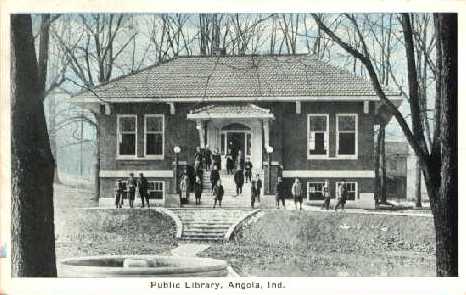
At the meeting of the city council Monday evening, R. E. Willis, in behalf of Mr L.C. Stiefel, tendered to the city a handsome ornamental fountain to be erected in McConnell Park in the space in front of the library.  Mr Stiefel's generous proposal included the cost of erecting the fountain which will be around $200.00, and all expense to the city will be supplying the water.  The council accepted the offer with an expression of thanks to the donor.  Mr Stiefel is now in New York, but he left arrangements to go ahead with the work, so that the fountain may be places in position by the time of the opening of the library.  He was notified at once of the act of the council, and will immediately place the order for the fountain.

The fountain chosen is of iron of handsome design.  It is about ten feet high, and has a series of three overflow bowls, which spread the water to the best advantage.

On the heels of this gift, the library board today received the tender of a pair of ornamental lamps on supporting posts, to be placed on either side of the approach to the library, from Mr and Mrs John A. Croxton and children. The offer will be accepted with thanks by the library board at its meeting this evening.

These generous acts by public spirited citizens will add much to the beauty of the park and library, and may perhaps lead to other gifts which altogether will make the grounds the most handsome in this part of the state.  The people of Angola appreciate the spirit in which the gifts were tendered and approve of the acts of the officers in accepting them without delay.

Steuben Republican August 11, 1915
-- The fountain was restored in 2004 and is now inside the library--